













Tracking progress through evolving health strategies: 2025–2030
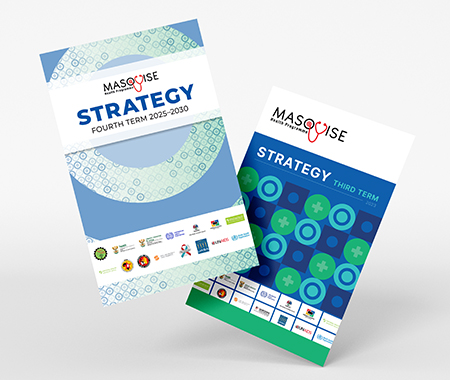
Explore our evolving strategy documents that guide the Masoyise Health Programme performance. The 2023–2024 strategy introduced mental health as a core focus, while the 2025–2030 strategy expands support for women’s health and wellbeing. Achievements include a drop in TB incidence to 223 per 100,000 and over 80% screening rates for HIV and NCDs. Download the strategy documents below.
DOWNLOAD 2025–2030 STRATEGY >DOWNLOAD 2023–2024 STRATEGY >
Industry performance against targets: 2020 to 2025
Swipe left to view the full table
| Activity | Milestone | 2020 | 2021 | 2022 | 2023 | 2024 | 2025 |
| Compliance to reporting | Companies on the system | 280 | 281 | 280 | 286 | 289 | 299 |
| Finalisation of reports (100%) | 83.7% | 91.5% | 91.2% | 90.4% | 93.8% | 97.6% | |
| HIV counselling, testing and ART treatment | HIV counselling (95%) | 67.3% | 67.1% | 81.7% | 91.4% | 81.6% | 87.9% |
| Annual HIV test (95%) | 43% | 49% | 63.7% | 62.7% | 75.2% | 76.5% | |
| ART Treatment (100%) | 56.2% | 46.4% | 47.1% | 44.3% | 43.1% | 54.8% | |
| TB screening | Annual TB screening (95%) | 68% | 75.4% | 81.7% | 92.7% | 85.6% | 88.4% |
| TB incidence | Below the national TB notification rate 5% year on year reduction for the TB notification rate per 100 000 population | 195 | 221 | 244 | 229 | 162 | 173 |
| NCDs | Employees screened for hypertension (95%) | 69% | 74% | 81.7% | 92.1% | 87.9% | 88.1% |
| Employees screened for diabetes (95%) | 61% | 59% | 80% | 91.5% | 84.1% | 89.7% | |
| Employees screened for obesity (95%) | Not part of framework | 87.3% | 83.2% | 88.8% | |||
| Employees screened for cholesterol (95%) | 32.6% | 27.5% | 72.5% | ||||
| Employees screened for mental health issues (95%) | 11.4% | 67.7% | 78.1% | ||||
| Linked to Mental Health Care (100%) | 38.9% | 76% | 80.7% | ||||
The population at risk for cholesterol screening was identified as all people that are obese, have NCDs as well as those who are HIV positive.
Cholesterol and mental health indicators were introduced as part of the Masoyise Health Programme reporting framework in 2023. As newly incorporated measures, baseline data was established during this period, and trends should therefore be interpreted with caution. These indicators reflect an expanded focus on non-communicable diseases and psychosocial wellbeing, in line with evolving industry health priorities.